.png)
.png)
_edited.png)
.png)
.png)
.png)


ST AUGUSTINE'S INTELLECTUAL BATTLE AGAINST HERESIES | KAIROS GLOBAL | MARCH 2024
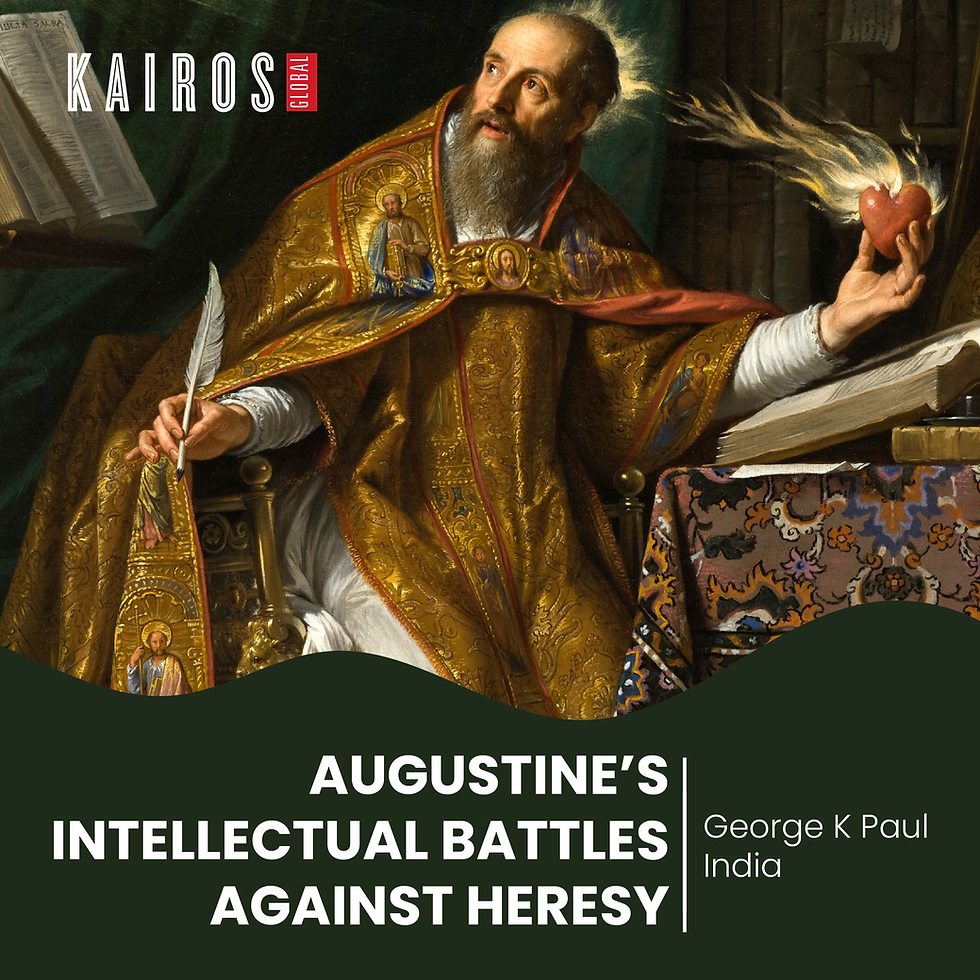
Author: George K Paul
Intro: George K Paul writes about St Augustine and how he countered the heresies of his time.
A heresy involves the disruption of a complete and self-sustaining system by introducing a novel denial of an essential part within it. Rejecting an entire system wholesale does not constitute heresy and lacks the creative impact of true heresy. The essence of heresy lies in its ability to leave a substantial part of the attacked structure intact. Due to this characteristic, heresy can appeal to believers and continues to influence their lives by diverting them from their original beliefs. Hence, it is often stated that heresies ‘survive by the truths they retain.’ The late Pope Benedict XVI emphasised that ‘every heresy is at the same time the cipher for an abiding truth.’ A cipher is akin to an encoded message, and decoding or deciphering it reveals a lasting truth. Therefore, heresies, in the process of being fought and deciphered, contributed to strengthening the Church. In the early years of Christianity, the prevalence of heretical ideas led to significant progress in the theological understanding of faith. This progress resulted from the thorough refutations of these ideas by some of the most brilliant minds in Christian history, with St Augustine of Hippo standing out as the most luminous among them.
Augustine, born on 13 November 354 in Tagaste, now Souk-Ahras, located about 60 miles from Bona (ancient Hippo-Regius), hailed from a modest family in the small free city of proconsular Numidia. His family, while respectable, was not affluent, and his father, Patricius, a pagan curial of the city, embraced Christianity around the year 371 due to the virtuous influence of Monica, Augustine's mother.
Excelling in studies in his hometown, Augustine's father, proud of his son's achievements, sought to send him to the thriving city of Carthage for further education. Augustine's idleness during the months it took to secure sponsorship led him into greater mischief. His father passed away that year, but a wealthy citizen of Tagaste offered to sponsor Augustine's education. By the time Augustine reached Carthage, he was ripe for a life of immorality, influenced by his peers, the allure of theatres, and literary successes. Soon after, he moved in with a young woman and fathered a child out of wedlock.
At the age of nineteen, Augustine's life took a turn when he read Cicero's Hortensius, which extolled the virtue of wisdom. This sparked a hunger for truth within Augustine, leading him to pursue it earnestly. Doubts about his Christian faith arose, primarily due to struggles with the Old Testament's perceived violence and confusion. He then encountered Manichaeism, a religious philosophy claiming secret knowledge and supporting his view that the Bible contained contradictions. While never formally joining, Augustine delved into their teachings in the hope of discovering the promised wisdom. Several years later, disillusioned by their leader, Faustus, Augustine abandoned Manichaeism.
After completing studies in Carthage, Augustine returned home to Tagaste with his girlfriend and son, teaching grammar at a local school. When considering becoming a Manichaean, his mother initially expelled him, but divine inspiration later prompted reconciliation. Successful as a teacher, he returned to Carthage to teach rhetoric, received an invitation to Rome, and left for Milan. Still searching for the truth, Augustine met the future saint, Bishop Ambrose of Milan. Ambrose was a great thinker and preacher. He also paid attention to Augustine, listening to him, offering him friendship, and answering his many questions. Ambrose introduced him to the proper reading of the Bible, especially helping him with his difficulties with the Old Testament.
One day, while in a garden, Augustine heard a child's voice saying, ‘Take and read.’ Picking up the Bible and randomly opening it to Romans 13:13-14, he was deeply affected and began his conversion hastily. Augustine spent time with Catholic friends, engaging in lengthy conversations, and found support from his uneducated yet wise mother. Coupled with Monica's tearful prayers, these factors led to Augustine's final conversion and baptism by Bishop Ambrose during the Easter Vigil in 387.
Upon returning to Tagaste, Augustine formed a religious community with his friends, becoming a source of hope for many. Acclaimed by the people, he became a priest in 391 and was consecrated as the bishop of Hippo in 396. Over his forty-three years as a Christian, Augustine emerged as one of the greatest theologians in Church history, transforming lives through pastoral work, regular sermons, and attentiveness to people's needs.
As the Christian Church was seriously faced with the three heresies of Manichaeism, Donatism, and Pelagianism chronologically around the lifetime of Augustine, he proved to be a central and influential theological leader that clarified and defended the Christian faith against these heresies. Augustine wrote many treatises and letters against these heresies, and this was how his theology was developed and formulated. His theology turned out to be highly creative and insightful, influencing later Christian theology.
Against Manichaeism
Manichaeism, originating from the Persian figure Mani in the third century, amalgamated various elements such as Zoroastrianism, the ancient Babylonian Ophitic religion, and Gnosticism. It established itself as a dualistic religion, attributing co-eternal status to the principles of light (representing God) and darkness (representing Satan). The influence of Manichaeism extended throughout the Roman Empire until the fifth century, even impacting Christian communities. Augustine, prior to his conversion, was drawn to Manichaeism for approximately nine years, driven by two primary considerations. Firstly, the dualistic worldview of Manichaeism, portraying the world as a blend of God and Satan, appeared to provide a plausible explanation for the pervasive presence of evil. Secondly, Augustine felt absolved of personal responsibility for his sins due to the fatalistic beliefs of Manichaeism. However, upon embracing Christianity, Augustine recognised the imperative to shield the Church from the influence of Manichaean heresy.
While Manichaeism posited limitations on God's power in the face of Satan, Augustine asserted God's omnipotence, supremacy, infiniteness, and immutability. Additionally, he refuted the Manichaean belief in Satan's eternal existence. Manichaeism's assertion of the world being a mixture of good and evil was contradicted by Augustine, who maintained that all creatures are inherently good, aligning with Neoplatonic philosophy. Augustine's concept of evil differed significantly from the substantial view held by Manichaeism. He presented evil as non-substantial, drawing parallels with Neoplatonism, where evil is defined as the privation of good (privatio boni). According to Augustine, evil constitutes the privation, diminution, or deviation (defectus) of a good being from its original state in terms of measure, form, and order. This evil, while a falling away from essence, remains non-substantial, existing as mere privation or diminution. Augustine countered the deterministic stance of Manichaeism, which deemed evil as necessary, by introducing an indeterminism that positioned evil as only a possibility. The rationale behind this possibility lay in the finite, changeable, and corruptible nature of all beings, originally created as good and participating in God as the infinite, unchangeable, and incorruptible supreme good.
In contrast to Manichaeism, which attributed the origins of evil to God and Satan without implicating humans, Augustine assigned the potential for evil to the ‘free will’ (liberum arbitrium) of rational beings, including angels and humans. Augustine posited that free will, initially created as good, could undergo privation or diminution of its original moral rectitude. This potential privation, exemplified in the case of Adam's fall, gave rise to moral evil, identified as sin. Augustine, however, grappled with explaining the inception of this moral evil, acknowledging a lack of a definitive answer to the question of its origins. While asserting that there is no efficient cause of an evil will, Augustine emphasised that God serves as the efficient cause of a good will, stating, ‘as to whence it [evil] is, nothing can be said.’
Augustine's refutation of Manichaeism, although it was quite Neoplatonic, issued in a distinctive definition of God, a non-substantive theme of evil, and a free-will defence, all of which became important elements of the Christian tradition.
Against Donatism
The Donatists, a sect of rigorist Christians, emerged as a heretical group in 311 when Caecilianus became the bishop of Carthage, consecrated by Felix, a former traditor (traitor) during the Diocletianic persecution (303-305). Questioning the validity of this consecration, they contested Caecilianus by establishing Majorinus in the same year, and in 315, Donatus succeeded Majorinus, giving the heresy its name. The Donatists asserted exclusive fidelity and purity, claiming that only within their Church could one find holiness adequate for administering sacraments. According to their beliefs, admission to the Donatist Church necessitated rebaptism. Persecuted by Emperor Constantine, the Donatists grew resentful, furious, and even violent, posing a significant threat to the unity of the Church.
Around 396, Augustine earnestly addressed this issue, providing a definitive response in his work ‘On Baptism, Against the Donatists.’ Augustine differentiated between the act of baptism itself and its effective application, asserting that the former exists universally, whether within or outside the Catholic Church. However, the latter, the efficacy of baptism, is realised only in a context where the unity of love is practiced, namely, the Catholic Church. In essence, baptism can be administered even by heretics and schismatics if done in the name of the Father, Son, and Holy Spirit, as the true source of baptism is divine, not human. The efficacy of a baptism received outside the Church becomes apparent upon returning to the Church, eliminating the need for rebaptism. Augustine acknowledged the imperfection of the Catholic Church, housing both virtuous and flawed Christians, but emphasised that the effective use of baptism is contingent on the mutual love within the Church. Augustine underscored the significance of love as an indispensable element of the Church in his ecclesiology.
While Augustine expressed love and compassion for the Donatist heretics, initially favouring gentle discussion and instruction for their return, he later recognised the need for a practical approach to counter the violence exhibited by armed Donatist zealots. Referring to Luke 14:23 (‘compel them to come in’), Augustine justified the use of force, a stance later adopted by the Church and unfortunately cited to justify the Inquisition. Augustine's role in this tradition has been criticised, but some argue that the negative assessment may not fully capture his perspective. Augustine seemingly viewed the use of force as an act of love rather than hatred, drawing parallels with instances where God, out of love, compelled correction and faith, such as Paul's conversion through physical blindness or forcibly saving people from imminent danger.
Against Pelagianism
Pelagianism, deriving its name from Pelagius, a contemporary of Augustine and a British monk, emphasised the moral capacity of Christians to remain sinless even without the supernatural assistance of divine grace. Pelagius asserted that divine grace is confined to the endowment of free will, law, and gospel, rejecting the concept of original sin. According to Pelagius, the challenges presented by Adam's poor example could be overcome through human moral efforts alone. The Pelagian controversy gained momentum when Coelestius, a talented young lawyer, became Pelagius's chief disciple, attracting considerable public attention. Theological disagreements on human nature, divine grace, and sin emerged, once again threatening the unity of the Church. Augustine, branding Pelagius as ‘the enemy of the grace of God,’ identified three heretical tenets of Pelagianism: the belief in God's redemption based on human merit, the notion that some individuals can lead a sinless life, and the idea that descendants of the first sinners are born innocent. Augustine portrayed Pelagius in his writings as a symbol of humanism, excluding God from the process of human salvation. Pelagianism significantly influenced Augustine's opposition to his own views on free will, grace, and original sin, with much of The City of God dedicated to refuting Pelagian arguments. A notable disparity between the two thinkers was Pelagius's emphasis on obedience to God out of fear of hell, which Augustine considered servile. In contrast, Augustine advocated that Christians should be motivated by the joy and blessings of the Holy Spirit, condemning actions done for the wrong reasons as a form of betrayal. Augustine attributed all virtue and good works solely to God, warning that suggesting otherwise leads to arrogance, the root of sin.
Augustine's extensive writings continue to be widely read and quoted in contemporary times. His literary corpus encompasses apologetics, sermons, letters, scripture commentaries, a monastic rule, as well as philosophical and theological treatises. Among his notable works is Confessions, an autobiographical masterpiece that delves into his internal conversion, intertwining personal reflections with profound theological insights. In City of God, another significant contribution, Augustine defends the Christian faith and challenges the notion that the sack of Rome in 410 resulted from the rejection of pagan gods. Instead, he draws a parallel between the city of man and the city of God, urging society to aspire to higher ideals. Augustine's influential treatise on the Trinity and numerous other works, including over 1,000 documents totalling more than five million words, have endured through the ages. In the final year of his life, he witnessed the destruction of Hippo by invading barbarians who wreaked havoc on churches and buildings, echoing events in Rome. Despite the devastation, Saint Augustine's lasting impact endured, transcending the confines of the Church and profoundly shaping Western thought. Further exploration of these topics will be featured in the upcoming issue.
George Paul is a Communication Designer currently working with the Catholic Health Association of India. An avid student of Theology, Philosophy and History, George helps youngsters connect with the Catholic intellectual tradition.


Comments