.png)
.png)
_edited.png)
.png)
.png)
.png)


CATHOLIC CONTRIBUTIONS TO SCIENCE | KAIROS GLOBAL | APRIL 2021
Author: Antony Sachin VR
Intro: Antony Sachin writes this informative and fact-filled article on Catholic contributions to science.
‘In the Middle Ages, they (Catholic Church) were [greatly] creative forces. Much of the new technological, economic, political and administrative techniques [of that period] were pioneered by the Catholic Church. The best equivalent for Silicon Valley in the 13th century was the Vatican. [For] all new ideas about administration, information processing, this is where you went, to the Vatican. The first archives, libraries, systems for archiving information, cataloguing information, this is something the Church was best at doing. If you were a king in the 13th century and you wanted somebody who knew how to handle information, to help you run your kingdom, you turned to monks. You turned to priests. So back then they were still very creative forces.’
These may seem the thoughts of a Church loyalist, but I was surprised to hear these words being uttered by the atheist Israeli historian Yuval Noah Hariri in a talk at Google in 2015. Harari, an author and professor in the Department of History at the Hebrew University of Jerusalem is opposed to many aspects and stances of the Church. Yet he, and many like him who look into the evidence from history, realise and acknowledge the contributions of the Church in the field of science and education. Yet sadly, the perception of the Catholic Church as being anti-science is gaining much traction these days. The Church is projected as the oppressor of the scientific achievements of the people like Galileo Galilei, Giordano Bruno, etc. and even some Catholics still think that the Bible is against science without knowing the official position of the Catholic Church on science and faith.
This article is a small attempt to set the record straight about the true history of the Church’s interventions in the journey of modern science as we know today.
We would scarcely call anyone ‘educated’ who had no knowledge whatsoever of History… - Fr. Frederick C. Copleston SJ, Jesuit Philosopher and Historian of Philosophy
Birth of Christianity
Christianity was born in Roman-occupied Israel and grew up in a cultural climate where Greek was the language of the educated and wealthy classes. Emperor Constantine embraced Christianity before his death in 337 AD and from 380 AD, Christianity was the official religion of the whole Roman Empire. In 330 AD Constantine, threatened by ‘barbarians’ from the north and by disintegration from within, moved his capital to Constantinople, splitting the Roman Empire into two – the Eastern Empire and the Western Empire. During the Great Schism of 1054, the Eatern Church became the Orthodox Church and the Western Church continued to be known as the Roman Catholic Church. Initially, there were many developments of science in the Eastern Empire compared to the West, but the invasions of Mohammedan invaders into the Eastern Empire in the 7th century gave the most serious blow to the scientific development in Christendom.
Milestones of Scientific Journey
Emergence of Benedictine Monasteries (6th century)
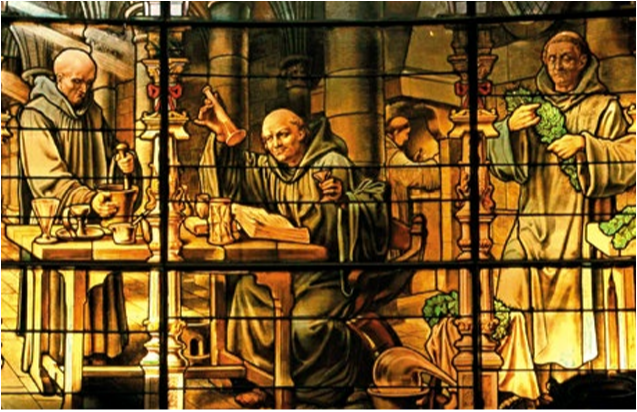
St. Benedict of Nursia (480–547 AD), patron saint of Europe and one of the patron saints of engineers, founded his monasteries not only on prayer, but also on work, following the guiding principle of ora et labora. And so, following their founder, monks took on civil and mechanical engineering activities like metalworking, building flood-control earthworks, draining swamps, and building reservoirs and mills. Monasteries were responsible for many of Europe’s cultural and technological ‘firsts’. Beginning in the 6th century, monastic communities created the first large-scale European system of schools, libraries, scriptoria, and infirmaries; the importance of which cannot be underestimated for the collection, preservation, production, and transmission of technical knowledge. The remains of the first known tidal-powered water wheel have been found in Ireland, at Nendrum Monastery Mill in Strangford Lough, dating to the early 7th to late 8th centuries. Modern musical notation originated with Fr. Guido d’Arezzo, O.S.B., (992–1033 AD) in Italy. The first impact-drilled well, and the first artesian well in Europe, was drilled by Carthusian monks in Artois, France, in 11261.
Carolingian Renaissance (800–900 AD)
By the 6th century, the Roman Empire succumbed to invasions of barbarian tribes. In 800 AD, the Frankish King Charlemagne (pronounced shaa-luh-mayn) was crowned emperor in Rome by Pope Leo III in an effort to transfer the Roman Empire from East to West. Charlemagne (aka Charles the Great) wanted to unite his large empire by means of a common culture centered on education. To that end, he asked the English monk, Alcuin of York (735–804 AD) to create a standardised academic curriculum. Alcuin, who was influenced by the writings of St. Bede (672–735 AD), obliged by creating the trivium (grammar, logic, rhetoric) and the quadrivium (arithmetic, geometry, astronomy, and music). Charlemagne created Cathedral schools throughout the empire, where boys and girls alike studied Alcuin’s curriculum. Charlemagne also patronised Benedictine monasteries, where the monks preserved classical Greek and Roman culture by copying ancient manuscripts that would then survive to be read during the later Italian Renaissance. As historian Joseph Lynch explains, ‘The writing, book copying, artistic and architectural work, and thinking of the men trained in the cathedral and monastic schools stimulated a change in the quality and quantity of intellectual life.’
The monks of Charlemagne’s empire were responsible for another, extremely important innovation in education. At the time, written scripts and fonts differed widely in various parts of Christendom, making it difficult for texts written in one region to be read and understood in another. In addition, there were no such things as lowercase letters, punctuation marks, or blank spaces between words. To standardise writing and make it more readable, the monks developed a standard script or font known as Carolingian minuscule, which was clear and uniform with rounded shapes, had clear capital and lowercase letters, punctuation marks, and had spaces between the words. Carolingian miniscule became the standard font for manuscripts in Christendom for nearly 400 years, and was even used outside the confines of Charlemagne’s empire. This script not only benefited education during the medieval period, it was ‘crucial to building the literacy of Western civilisation’2.
Origin of the First Western Medical School
The medical school at Salerno, Italy emerged in the 9th century, revived the tradition of the ancient schools. Three important factors determined the success of the Salernitan School: first, medical education in Salerno began in the Benedictine monasteries, resulting in association between medical learning and hospitals of the Church. Connection with the monastery at Monte Casino and Benedictine traditions promoted intellectual development in a liberal atmosphere, which enabled students of all backgrounds, including women, to attend the school.
With its mild climate, Salerno was considered a health resort where travellers and nobility came to recuperate from various ailments. Aggregation of the sick at Salerno attracted Greek, Arabic and Jewish physicians. In addition, collections of literary material preserved in the monasteries drew students of medicine from all over Europe, Spain and Asia Minor.
The third factor that promoted the success of the school was its geographic location in Southern Italy. The school was located in the middle of an elevated valley, overlooking the town of Salerno, southeast of Naples. Proximity to surviving remnants of Greek culture promoted learning of Ancient Masters, such as Hippocrates and Aristotle.
12th Century Renaissance
The university, which developed and matured at the height of Catholic Europe, was a new phenomenon in European history. Nothing like it had existed in ancient Greece or Rome. The institution that we recognise today, with its faculties, courses of study, examinations, and degrees, as well as the familiar distinction between undergraduate and graduate study, comes to us directly from medieval Europe
.
The papacy played a central, if not exclusive role in the establishment and encouragement of the universities. Naturally, the granting of a charter to a university was one indication of this papal role. The first university was founded at Bologna at the end of the eleventh century. The University of Paris was erected in 1150, Oxford in 1167, and Cambridge in 1209. In total, 81 universities were founded before the mid-16th century. Of these 33 possessed a papal charter, 15 a royal or imperial one, 20 possessed both, and 13 had none. In addition, it was the accepted view that a university could not award degrees without the approbation of Pope, king, or emperor. Pope Innocent IV officially granted this privilege to Oxford University, for example, in 1254.
The Pope (in fact) and the emperor (in theory) possessed authority over all of Christendom, and for this reason it was to them that a university typically had to turn for the right to issue degrees. Equipped with the approval of one or the other of these universal figures, the university’s degrees would be respected throughout all of Christendom. Degrees awarded only by the approval of national monarchs, on the other hand, were considered valid only in the kingdom in which they were issued. In certain cases, including in particular the universities at Bologna, Oxford, and Paris, the master’s degree entitled the bearer to teach anywhere in the world.
The Pope also granted the university a separate papal jurisdiction, thus emancipating the institution from the interference of what had been an overbearing diocesan authority. The distinction between undergraduate and graduate education was made in the early universities more or less as it is today.
According to the historian of science Edward Grant, the creation of the university, the commitment to reason and rational argument, and the overall spirit of inquiry that characterised medieval intellectual life amounted to ‘a gift from the Latin Middle Ages to the modern world…though it is a gift that may never be acknowledged. Perhaps it will always retain the status it has had for the past four centuries as the best-kept secret of Western civilization.’3
According to Michael Shank, Professor of the History of Science at University of Wisconsin-Madison, ‘The thirteenth century marks a turning point in the histories of world culture and of the scientific enterprise. The emerging universities institutionalised learning, giving the teaching, study, and advancement of theoretical approaches to natural knowledge a permanent home. The ups and downs of the intervening history notwithstanding, the partnership of the scientific enterprise with the university still thrives today. The medieval universities not only created a quasi-autonomous space for natural philosophy and the mathematical sciences in the faculties of arts, but also institutionalised law, medicine, and theology. Masters in the last two faculties often continued to develop the natural philosophy and the mathematical and analytical tools of their earlier education.’4
Jesuit Contribution to Science
By the mid-16th century, the Catholic Church was gifted with a wonderful religious congregation (Society of Jesus) founded by St. Ignatius of Loyola and six companions with the approval of Pope Paul III in 1540. The members are called Jesuits (SJ). Jesuits have made remarkable contributions in almost all the fields of science. 35 lunar craters and 11 asteroids have been named after Jesuit scientists.
In fact, one of the moon’s largest crater formations is named after Fr. Christopher Clavius (1538–1612). His astronomical and mathematical genius played a major role in the formation of the Gregorian calendar, the calendar system in almost universal use today. Clavius encouraged a number of mathematical developments: the decimal point, parenthesis, use of logarithms and the Vernier scale. Fr. Giovanni Battista Riccioli (1598–1671) was known for his experiments with pendulums and with falling bodies, and for introducing the current scheme of lunar nomenclature. He is also widely known for discovering the first double star.
Fr. Athanasius Kircher (1602–1680), wrote about a wide range of scientific issues –astronomy, magnetism, volcanoes, earthquakes, disease, geography, antiquarianism, among others and organised a museum of natural history (which both served as a repository of curiosities and as a spur to experimentation). Fr. Roger Boscovich (1711–1787) developed a dynamic atomic theory that unified all natural forces and made many contributions to astronomy, including the first geometric procedure for determining the equator of a rotating planet from three observations of a surface feature and for computing the orbit of a planet from three observations of its position. In 1753 he also discovered the absence of atmosphere on the Moon.
Jesuit missions across the world also aided their scientific efforts. Fr. Matteo Ricci (1552–1610) successfully predicted a solar eclipse on September 22, 1596, earning him the opportunity to work with Xu Guangqi, an open-minded Chinese scholar on reforming the Chinese calendar system. The new calendar provided more accurate predictions of eclipses of the sun and the moon and better guidance for planting and harvesting. Ricci was the first westerner to be invited to China and appointed as an advisor to the Chinese emperor. This calendar reform marked the first major collaboration between scientists from Europe and China and also in establishing the China mission.
Likewise, Fr. José de Acosta (1539–1600) mapped the terrain, flora, and fauna of Central and South America. Many scientific books were written by Jesuits and many observatories were set up wherever they carried their mission. Fr. Eugene Lafont (1837–1908), had the distinction of introducing modern science into India with his knowledge of experimental physics and his ability to popularise science among the people. He was called the ‘Father of Science’ in India. Sir J. C. Bose and Dr. C. V. Raman (Nobel laureate) found encouragement for their introduction to science in the person of Fr. Eugène Lafont.
The ‘Hurricane Priest’ who laid the groundwork for the hurricane warning systems we use today is Fr. Benito Viñes SJ (1837–1893). Hurricanes and cyclones in the Caribbean and Asia encouraged Jesuit missionaries to study weather phenomena, with the worldwide distribution of observatories and the centralisation of data through the order allowing them to establish global patterns. Jesuits have contributed so much to the development of seismology and seismic prospecting that seismology has been called the Jesuit science. Jesuits founded their own seismological association and seismological stations were set up all over the world.
Other contributors to this scientific galaxy include Fr. Angelo Secchi (1818–1878), in the mid-nineteenth century, pioneered the use of spectroscopy for solar and stellar research; Fr. Stephen Joseph Perry (1833–1889), also active in the mid-nineteenth century, studied geomagnetism (positing the relationship between the variations in the terrestrial magnetic field and the magnetic pole) and led scientific expeditions for the Royal Society. Fr. James Bernard Macelwane (1883–1956), wrote the first textbook of seismology; and Fr. Pierre Teilhard de Chardin, in geology and palaeontology, who was also famous for his influential thought on the relation between evolution and Christian faith. Brother Guy J. Consolmagno, the present director of Vatican Observatory (www.vaticanobservatory.va) is also an American Jesuit.5
Christianity, the cradle of modern science
Almost all the civilisations that came after the Greeks (Romans, Christians & Arabs) relied on Greek Science, especially on the works of Aristotle (384–322 BC). Aristotle was a Greek philosopher and polymath during the Classical period in Ancient Greece. He was the tutor of Alexander the Great. He taught subjects such as logic, physics, public speaking, politics, and philosophy. Aristotle had new ideas on how the world should be studied. Pythagorean Theorem, Euclidean geometry, Archimedes' principle (physical law of buoyancy) taught in our schools are the contributions of ancient Greek Science.
Christians understanding of Cosmology was based on the famous astronomer Claudius Ptolemy (100–168 AD), who lived in the city of Alexandria. His model of the solar system was geocentric, where the sun, moon, planets, and stars all orbit the earth in perfectly circular orbits which was universally accepted until 15th century Catholic astronomer and canon lawyer, Nicholas Copernicus (1473–1543) came up with a heliocentric model. Later Galileo, a devout Catholic made an observable telescope to prove the heliocentric theory.
From the time of the Greeks to the 15th Century, there was no solid proof for the rotation and revolution of earth around the sun. With our naked eye, it was impossible to understand that the earth was rotating (because we do not feel its rotation) and also that it was revolving around the sun. They assumed that the sun and other stars rotated around the earth. The heliocentric theory, baked by an observable telescope was a breakthrough achievement, and the later discoveries of Sir Issac Newton (English scientist & theologian) gave more clarity in this area.
Aristotle had a pantheistic worldview, meaning ‘God is everything and everything is God.’ This view was shared by almost all the ancient civilisations, but it went totally against the Christian theology of monotheism because Christians believed in a transcendental God, i.e. God is beyond space and time. This understanding was based on the Bible and also Christian theologians and scientists rejected the notion of an eternal universe. They believed that the universe had a beginning as accounted in Genesis 1:1, but there was no evidence until Fr. Georges Lemaître (1894 –1966), a Belgian Catholic priest, came up with a new theory called ‘Big Bang’ for the origin of the universe. Lemaître’s theory was based on Albert Einstein’s Theory of Relativity. Albert Einstein later accepted his theory, even though he had an initial understanding of an eternal universe.
John Philoponus (490–570 AD), a Byzantine Christian was one of the first to propose a ‘theory of impetus’ similar to the modern concept of inertia over Aristotelian dynamics. This theory was later developed by Jean Buridan (1301–1359) a Catholic cleric, teacher in the faculty of arts at the University of Paris, who sowed the seeds of the Copernican revolution in Europe. He refined the concept of impetus with many experiments, the first step toward the modern concept of inertia and an important development in the history of modern science. The theory of impetus was a precursor to the concepts of inertia and momentum in classical mechanics.
In Buridan's writings, perhaps for the first time, the heavens and the earth were at least tentatively subjected to a single set of laws, and the same suggestion was carried further by Buridan's student, Nicole Oresme (Bishop). He suggested that, ‘when God created [the heavens] ... , He impressed them with a certain quality and force of motion, just as He impressed terrestrial things with weight … ; it is just the same as a man building a clock and leaving it to run itself. Thus, God left the heavens to be moved continually … according to the order [He had] established.’6
To learn more details about this topic, I would suggest reading Stacy Trasancos, Science was born of Christianity, The teaching of Father Stanley L. Jaki, 2013.
Giovanni Battista Guglielmini (1763–1817), a cleric and Catholic scientist from Bologna, is known as the first scientific experimenter on the mechanical demonstration of the earth's rotation. The most celebrated test of the Earth's rotation is the Foucault pendulum first built by French physicist Léon Foucault in 1851, who later became a practicing Catholic.
Rodney Stark, professor of sociology and of comparative religion at University of Washington, researched ‘scientific stars’ from 1543 to 1680, the era usually designated as the ‘scientific revolution’, and came up with a list of the top 52 scientists. Of these, 26 were Protestant and 26 Catholic; 15 of them were English, 9 French, 8 Italian, 7 German (the rest were Dutch, Danish, Flemish, Polish and Swedish respectively). Only one was a sceptic (Edmund Halley) and one (Paracelsus) was a pantheist. The other 50 were Christians, at least 30 of whom could be characterised as ‘devout’ because of their evident zeal. It is not until Charles Darwin (1809–1882) that atheism appeared to accomplish anything significant in science.7
In Conclusion
Thomas Woods notes in his book, How the Catholic Church Built Western Civilization, ‘Cathedrals in Bologna, Florence, Paris, and Rome were designed in the seventeenth and eighteenth centuries to function as world-class solar observatories. Nowhere in the world were there more precise instruments for the study of the sun. Each such cathedral contained holes through which sunlight could enter and timelines (or meridian lines) on the floor. It was by observing the path traced out by the sunlight on these lines that researchers could obtain accurate measurements of time and predict equinoxes.’ In the words of J. L. Heilbron of the University of California, Berkeley, the ‘Roman Catholic Church gave more financial aid and social support to the study of astronomy over six centuries, from the recovery of ancient learning during the late Middle Ages into the Enlightenment, than any other, and probably, all other institutions.’
Historically, Catholics are numbered among the most important scientists of all time, including Rene Descartes, who discovered analytic geometry and the laws of refraction; Blaise Pascal, inventor of the adding machine, hydraulic press, and the mathematical theory of probabilities; Augustinian priest Gregor Mendel, who founded modern genetics; Louis Pasteur, founder of microbiology and creator of the first vaccine for rabies and anthrax; Johannes Gutenberg, founder of the printing machine. It is very difficult to articulate Catholic Contributions to Science in a few pages, but I have tried to give a glimpse of some of the main areas.
1 Green, Brian, ‘The Catholic Church and Technological Progress: Past, Present, and Future’, Religions 8.6 (2017): 106.
2 Weidenkopf, Steve. The Real Story of Catholic History Answering Twenty Centuries of Anti-Catholic Myths, 77-79
4 Harrison, Peter, Ronald L. Numbers and Michael H. Shank, eds, Wrestling with Nature: From Omens to Science, 84
5 Udías, Agustín, Jesuit Contribution to Science - A History, Springer, 2014
6 Jaki, Stanley L., Science and creation: From Eternal Cycles to an Oscillating Universe, Gondolin Press, Kindle Edition
7 Stark, Rodney, For the Glory of God: How Monotheism Led to Reformations, Science, Witch-Hunts, and the End of Slavery, 2004
Antony Sachin is presently active in a full-time media ministry called CatholicVibes, a YouTube channel about the Catholic Faith. He lives in Ernakulam, India.


Comments