


PUTTING ON CHRIST | KAIROS GLOBAL | NOVEMBER 2026

Author: Ankitha Poothavelil
Intro: Ankitha Poothavelil writes about the history of vestments worn by consecrated men and women.
The Mysterious Young Man
In Mark’s Passion narrative, there is a detail that is often overlooked. It happens immediately after the arrest of Jesus. Now a young man followed him wearing nothing but a linen cloth about his body. They seized him, but he left the cloth behind and ran off naked (Mark 14:51-52).
Readers, myself included, often gloss over this part. The fleeing of a young man seems inconsequential in the face of the betrayal and arrest of Jesus. Yet more attentive readers, puzzled by the evangelist’s decision to include this seemingly insignificant detail, have tried to make sense of it. The identity and significance of the young man remain disputed. Some ancient and modern interpreters have identified him with Mark himself, while others have proposed different possibilities. Even the nature of the linen garment has been debated. Was it an ordinary outer garment? A night garment? Does it carry some symbolic significance? The text itself does not give us a definitive answer. What is striking, however, is how much meaning readers have attempted to draw from a single piece of clothing.

Before There Were Habits
Clothing can say a lot about a person: their occupation, passions, beliefs, social standing and even the community to which they belong. It is often one of the first things we notice about someone. Perhaps the most distinctive clothing, and dare I say, most character, are the habits worn by religious sisters and brothers within the Church.
Because of the multiplicity of religious orders and institutes, it is impossible to give an exhaustive history of their habits in one article. However, let us take a cursory look at the beginnings of religious clothing. It might even give you a few factoids to wow your religious friends at the next meeting.
Before religious orders emerged, there were monastics; before organised monastic communities took their familiar forms, there were Christian ascetics and philosophers. St Justin Martyr, the second-century Christian philosopher and apologist, continued to wear the pallium, the cloak associated with philosophers in the Roman world. His clothing reflected his public identity as a Christian philosopher. Tertullian likewise wrote about the pallium and its significance for Christian ascetic life.
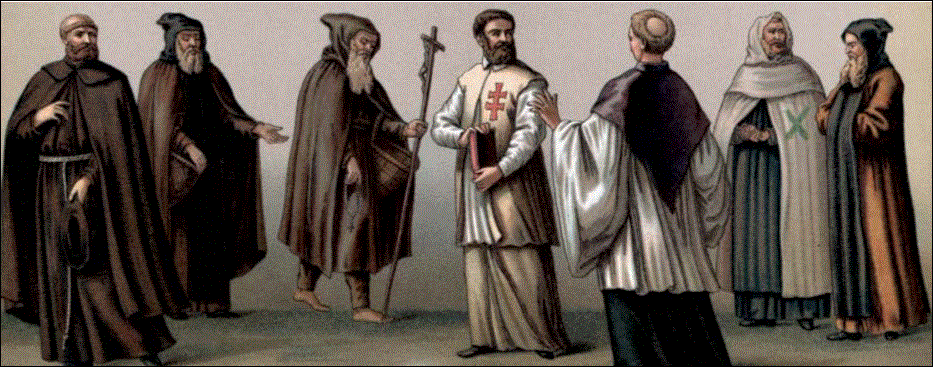
Christian asceticism eventually found one of its most dramatic expressions in the deserts of Egypt and Syria. The development of monasticism cannot simply be attributed to the legalisation of Christianity; ascetic practices existed before Constantine, and the great desert movement developed over several centuries. St Paul of Thebes is traditionally regarded as one of the earliest Christian hermits. According to his fourth-century biographer, St Jerome, Paul lived in the Egyptian desert and made a tunic from palm leaves.
Necessity Turns to Symbolism
For these early ascetics, clothing was initially a matter of necessity, poverty and simplicity rather than a carefully designed uniform. Over time, however, particular garments became associated with the monastic way of life.
St Augustine and St Benedict both maintained a remarkably practical approach to clothing. Augustine warned his communities against making clothing an object of vanity or distinction. In his Rule, he instructed religious to avoid conspicuous dress and to receive clothing from a common wardrobe according to need.
St Benedict was similarly practical. In Chapter 55 of his Rule, he instructed that clothing should correspond to the climate: monks in colder regions would need more, while those in warmer regions would need less. A monk was to have a tunic and cowl, along with a scapular for work and appropriate footwear. The clothing was to be inexpensive and locally obtainable, and monks were to return old clothing to the community wardrobe so that it could be given to the poor.
In other words, the earliest monastic clothing was not primarily intended to make monks visually distinct from everyone else. It was meant to serve the practical demands of a life of prayer, work, poverty and community.
Women should not be left out of this history. Consecrated virginity predates the organised monasticism of later centuries and was one of the earliest forms of consecrated Christian life. The writings of St Jerome provide glimpses into how women expressed their renunciation of worldly status through clothing. In his writings about women such as Marcella and Demetrias, he describes them exchanging expensive and elaborate clothing for simple tunics and cloaks as an outward expression of their dedication to God.
Clothing as Penance
Clothing could also become an instrument of penance. Although the hair shirt was one of the more common garments used for this purpose, some saints took penitential practices to extraordinary lengths. St Margaret of Hungary, a thirteenth-century Dominican nun, is one such example. Among her severe ascetic practices, she deliberately wore garments infested with lice. At one point, she reportedly wore a fur garment on her back that was deliberately left infested with lice, embracing the discomfort as an act of penance and mortification.
When the Habit Became an IdentityDuring the Middle Ages, the clothing of religious men and women gradually became more distinctive. The taking of the habit increasingly came to signify the assumption of a new way of life. In the ninth century, Benedict of Aniane, working under the patronage of Emperor Louis the Pious, became a major figure in the reform and standardisation of monastic life. At the Council of Aachen in 817, efforts were made to establish greater uniformity in monastic discipline and observance throughout the empire, including matters concerning the habit.
Yet distinctive habits did not automatically guarantee distinctive lifestyles. Monasteries could become wealthy, and reform movements repeatedly arose in response to the perceived loss of the austerity of earlier monasticism.
The Cluniacs, Camaldolese and Cistercians were among the communities that sought various forms of renewal. Clothing became one of the visible expressions of these differences. The Benedictines eventually became particularly associated with black, although the Rule of St Benedict itself never prescribed black as the colour of the habit. The Cistercians, meanwhile, originally used undyed wool. Its colour could vary according to the natural colour of the local wool; the familiar white cowl became standardised only later.
Then came the great mendicant movement of the thirteenth century. The Franciscans, Dominicans, Carmelites and Augustinian friars developed forms of religious life that differed significantly from the older monastic model. Rather than being centred primarily on enclosed monasteries and landed communities, the mendicants were strongly oriented toward preaching and ministry, particularly in growing towns and cities. Their poverty and itinerant apostolic life were reflected in their simple habits.
St Clare of Assisi, who followed St Francis, likewise embraced radical simplicity. The early Poor Clare tradition associated her community with coarse clothing, a cord, a veil and simple footwear. Clare's life shows how clothing could become an unmistakable sign of a woman's renunciation of worldly status and her dedication to Christ.
More Than a Uniform
Religious habits have continued to develop throughout the centuries. Some communities have preserved forms of clothing that can be traced to medieval traditions, while others have modified or abandoned the traditional habit altogether. Today, it is often possible to identify a religious order simply by looking at the colour and shape of its habit.
Yet the habit is more than an ecclesiastical uniform.
When a man or woman exchanges ordinary clothing for the habit of a religious community, something more profound is taking place. The garment becomes an outward sign of an inward change: a new belonging, a new way of life and a new identity. The religious are no longer dressing primarily according to personal preference, fashion or social status. The habit announces, in a visible way, that this person has given himself or herself to Christ and to a particular community within the Church.
This brings us back to that curious young man in Mark's Gospel. Whatever his identity or the precise significance of his linen garment, Mark leaves us with an unforgettable image of someone running away leaving his clothing behind.
The history of religious clothing tells almost the opposite story.
The religious take off the old garments and put on a new habit. In the language of St Paul, the Christian is called to put on the Lord Jesus Christ (Romans 13:14) and to put on the new self (Ephesians 4:24). The habit therefore becomes a visible reminder of an invisible reality: a person who has chosen to leave something behind and to belong, in a new way, to Christ.
Clothing may seem like a superficial thing. But sometimes, as Mark’s mysterious young man reminds us, a single garment can tell us far more about a person than we might expect.
Bibliography
Kuhns, Elizabeth. The habit: A history of the clothing of Catholic Nuns Kuhns, Elizabeth. New York: Image Books/Doubleday, 2003.
Killeen, Peter F. Dissertation. The Development and Significance of the Religious Habit of Men. Dissertation, Catholic University of America ProQuest, UMI Dissertations Publishing, 2015.
Ankitha Robin Poothavelil is a theology student at the Chicago Theological Union, where she is pursuing her master’s degree. She lives in Chicago with her husband. She dreams of starting a Catholic podcast for young adults one day.


Comments