


LEARNING TO BEHOLD BEAUTY IN THE WANING | KAIROS GLOBAL | SEPTEMBER 2026
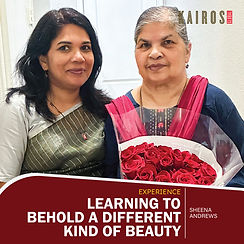
Author: Sheena Andrews
Intro: Caring for her ageing mother brought Sheena Andrews to the realisation of a beauty she had never thought of before.
Something recently struck me, almost as a revelation: the beauty of God’s creation reflected in the human body at every stage of life and our flawed ability to behold that
…
In the beginning, God created Adam and Eve and beheld them with delight. They, too, looked upon one another with the same pure gaze through which God saw them – with wonder, tenderness, and joy. Their bodies were never objects of shame, but testaments of divine beauty. They saw each other just as God intended them to see each other. Original sin distorted that vision. Their eyes, once capable of beholding beauty without fear, became blurred by shame and self-consciousness. They hid their bodies not only from one another, but even from God Himself.
But through Christ, when humanity was restored, we have been granted the freedom of sight beyond our outward imperfections and learning to behold the deeper beauty that radiates through body, mind, and soul. That is the grace toward which we are continually being drawn through the love of Christ poured upon us.
Throughout my life, I have been entrusted with the care of tiny, fragile human bodies — first in my profession as a neonatal nurse and later nurse practitioner, and then as a mother of seven children. Countless times, have witnessed new life emerging from the womb in every shade, size, and condition: bodies formed with visible perfection and sometimes bodies marked by fragility or incompleteness. Yet in each, the beauty and goodness of God was unmistakable.
As a mother, I delighted in watching those little bodies grow and transform into ever more beautiful forms. Caring for them was never just functional; it was deeply relational and also gratifying. Feeding them, bathing them, dressing them, matching their tiny accessories, singing to them, dancing with them, nurturing every inch of their bodies with tenderness and joy – all of it filled my heart with profound satisfaction. Through touch, gaze, and faithful care, love became embodied.
In the neonatal intensive care unit, I also witnessed the hidden beauty unfold. Caring for babies born at earlier gestational ages allowed me to glimpse, in the open, the sacred mystery ordinarily concealed within a mother’s womb. Day after day, over many weeks and months, I watched fragile lives slowly strengthen and thrive toward fullness. Even amid suffering and uncertainty, God’s goodness revealed itself quietly and persistently through those tiny bodies growing and developing against odds.
As my own children grew, I often marvelled at how beautifully God gathers features, temperaments, gestures, and expressions from generations before them and puts together a beauty entirely new and unique – a beauty no human being can claim credit for. Yet the world, with its fractured vision, reduces such beauty to measurements, comparisons, and passing cultural standards and fashion trends.
My own body, too, changed through the years – through seasons of pregnancies and postpartum, exhaustion and ageing. There were times I struggled with body image. But eventually I was able to arrive at a place where I could look at my body, one that had become a conduit of life again and again, and recognise that even scars of the process only added to the beauty of my being. The marks left behind by love and self-giving are not disfigurements; but witnesses.
All of this felt beautiful and comprehensible – until I began caring for my ageing mother.
Something within struggled to reconcile the sacredness of the body that once carried me with the frailty I now encountered. This was the body in which I was formed. These were the breasts that nourished me, the hands that fed me and steadied my first steps, the chest upon which I once rested peacefully, the face I kissed countless times as a child. My beautiful mother, whom I admired and longed to be like.
And yet, when I encountered her weakness, her wrinkles, her dependency, her diminishing strength and failing mind, I found within myself not only tenderness, but also awkwardness, frustration, and even resentment.
Why could I not behold the beauty in her ageing body as easily as I beheld the beauty of an infant? Why could I not care for every part of her with the same joyful reverence I offer my children? Why did the slow movements of age bother me while the slow growth of infancy and childhood delight me? Why was a body moving toward decline more difficult to embrace than one moving toward development?
It reveals my frailty, my brokenness, and the poverty of my love. It exposes how easily I cherish what appears to be unfolding into greater beauty while struggling to accompany what seems to be fading away. But I believe this, too, is part of my purification and redemption – learning to become a faithful steward not only of life that is blossoming and destined to conquer the world, but also of life that is slowly returning to its Creator to attain heavenly glory and perfection. The elderly body is no less sacred than the infant body. It is simply carrying a different mystery or even continuing the same mystery of God’s creation.
And then I think of Mother Mary.
What must it have been for her to gaze upon the broken body of her Son as He was laid across her lap? His body, once radiant with the fullness of life, now wounded and disfigured beyond recognition. Yet surely she held Him with unfathomable tenderness. Surely she still beheld His glory even when His form was destroyed beyond recognition. Her love did not recoil from brokenness; it remained steadfast before it.
Given the chance, would she not have continued caring for His wounded body for the rest of her earthly life with reverence and devotion?
Isn’t that what she continues to do now for the Mystical Body of Christ – tenderly nurturing every frail, broken, wounded, ageing, forgotten, and suffering member with the same love with which she once cradled her Son?
And holiness is learning, little by little, to see as she saw, to do as she does.
Sheena Andrews lives in Houston, USA, with her husband Sebastian Andrews, their seven children, and her mom. She is a neonatal nurse practitioner at Texas Children's Hospital and loves spending her spare time reading and gardening.


Comments