.png)
.png)
_edited.png)
.png)
.png)
.png)


JUSTICE, FAITH AND PEOPLE ON THE FRINGES | KAIROS GLOBAL | FEBRUARY 2026

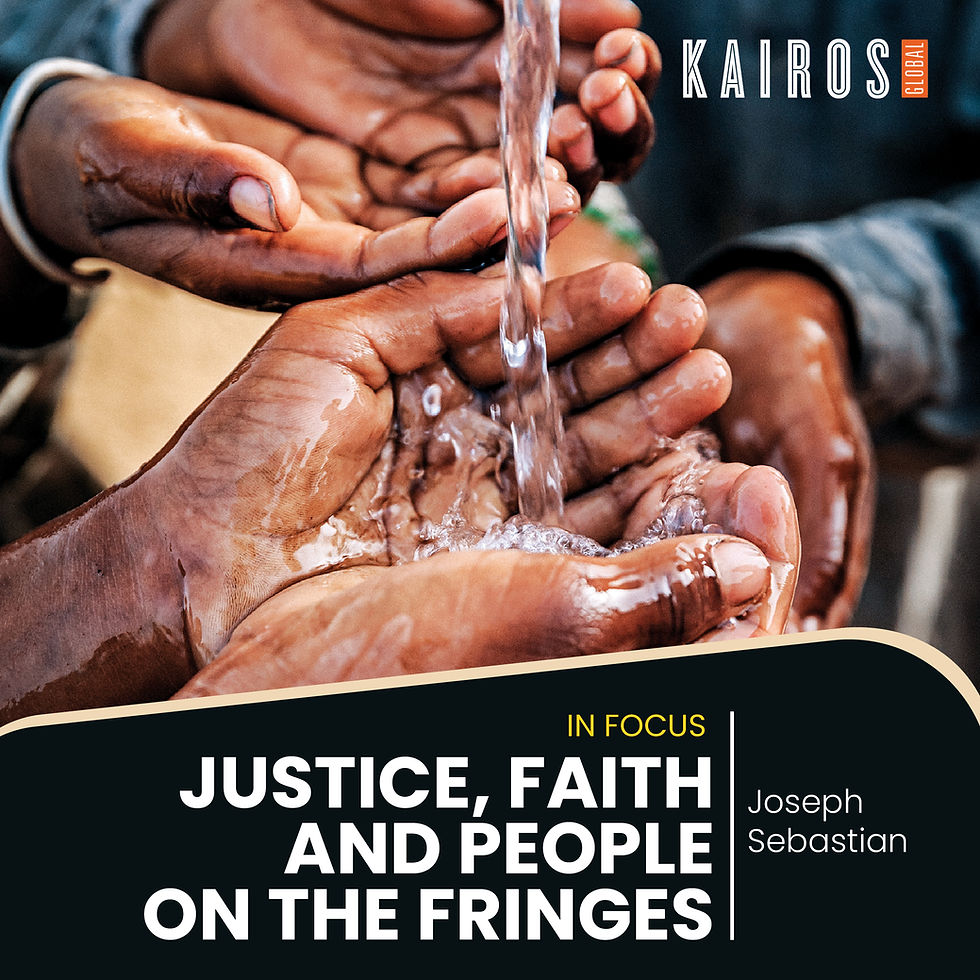
Author:Joseph Sebastian
Intro: Dr Joseph Sebastian calls on us to open our eyes to the injustice and inequities that occupy our everyday life.
Keshav (name changed) lives in the city, a cobbler and is ‘homeless’. For the past fifteen years, he has worked, slept on the same street, under the shade of a tree – come rain, come winter – using the public toilets and eating at the street vendors. Before that, he worked and lived on another street in the same city for nearly ten years, until he had to ‘relocate’ as part of a road-widening and city beautification project. The city moved on. Keshav moved a few hundred metres away.
Yet Keshav is not homeless in the way we usually imagine. His native place is a small village, where he has a home and a family. His aged mother, wife and three children live there. What he does not have is an affordable place to live in the city where he works.
So, Keshav made a choice. Instead of paying rent in the city, he sleeps on the pavement. The money he saves goes toward his children’s schooling and his family’s basic needs back home. Each night under the tree is a quiet sacrifice made for a future he may never fully share. You and I may let go of a stylish dress or a meal at the restaurant to get a gift for someone we love; Keshav goes without a roof over his head so that his family back home can get a bit more than just survive.
Keshav is not alone. There are many like him, whom Mahatma Gandhi called the unseen daridra narayana (meaning poorest of the poor) and Pope Francis defined as those on the fringes.
They (men, women, children, and entire families) come to the cities to earn a living by making the lives of the better-off liveable. They pull our rickshaws and drive our cabs; the rickshaw and cab become their home too. They sell vegetables at the roadside, clean our homes, guard our buildings, care for the elderly, and raise our cities brick by brick as construction labourers. They work long hours in spaces we rarely notice, and return at night to lives lived on the margins: in slums, makeshift shelters, broken buildings, or, at times, on the streets.
Their labour is essential, yet their presence is often treated as temporary, invisible, or inconvenient. They are welcome for their work, but not always for their lives. The city needs their hands but not always their humanity.
Inequity is not limited to the streets where Keshav sleeps. It is everywhere: in schools where some children have laptops and private tutors, while others share a single textbook and a few may never even enter school, or live in areas where there are no schools, or where schools exist but lack teachers and books; in workplaces where some are overpaid for easy work while others toil for survival and some remain unemployed; in neighbourhoods where clean water and safe streets are taken for granted by some and denied to many. It exists in daily life, health care, transport, housing, and even in the digital world. These gaps are not random. They are shaped by social hierarchies – castes, class, economic systems, and policies that favour some lives while leaving others with far fewer choices; structures that notice the privileged, yet often overlook those on the margins.When we see Keshav’s life and the inequities around us, Catholic Social Teaching (CST) helps us understand and respond. At its heart is the dignity of every human person: each life matters, not because of money, status, or convenience, but simply because every person is created in the image of God. Keshav’s worth is not less because he sleeps on the pavement, nor more because of the sacrifices he makes; it exists simply because he is human.
CST has developed over more than a century, as the Church responded to the challenges of society. It began with Pope Leo XIII’s encyclical Rerum Novarum (1891), which spoke about the rights of workers and the duties of employers, and continued through documents like Quadragesimo Anno (Pope Pius XI - 1931), Populorum Progressio (Pope Paul VI - 1967), and Laudato Si’ (Pope Francis - 2015). These encyclicals focus on social justice, economic fairness, and care for the vulnerable, with Laudato Si’ also strongly emphasising care for the environment.
In the present era, Pope Francis reminds us that the Church is called to see and stand with people on the fringes, those whom society often ignores, and that the mission of the Gospel is to bring joy, hope, and inclusion to all, especially the poor and excluded (Evangelii Gaudium).
CST also calls us to solidarity, walking with those on the margins rather than looking away, and to a preferential option for the poor, recognising that some lives are made more fragile by social and structural systems. Injustice is rarely just about individual actions; it is often built into the very way society is organised, shaping who gets opportunities, who is noticed, and who is left behind.
For Christians, these are not abstract rules, they are convictions that call us to notice, to care, and to act. They challenge us to ask ourselves: Who do we really see? Whose lives matter in our cities, schools, workplaces? How can we walk in solidarity with those whose dignity is often overlooked?
In one of my earliest experiences working among street children, I met Suni, a Tamil boy living on the streets of Kochi, Kerala. I was part of a research team studying drug abuse among street children, and Suni immediately stood out. There was a quiet attentiveness about him, a focus yet mellowed spark in his eyes, uncommon for a child his age.
Over time, I learned his story. Suni was from Salem. He belongs to a stable and well-off family; his father a landlord. But when Suni was about four years old, his mother died. His father remarried, and life changed drastically. His stepmother treated him harshly, and by the age of seven, Suni ran away from home. For more than four years, he had lived on the streets of Kochi when I met him.
Yet Suni carried something unexpected within him – love. He spoke often of his younger sister, born after his father’s remarriage. Despite the pain he experienced, he loved her deeply. When I asked if he ever went home, he told me that once every year, he returned (quietly) for his sister’s birthday. He would buy her a dress and give it to her as a gift, and then leave.
Unlike most children on the streets, Suni already had a savings account and was careful about putting money aside. I assumed he was saving to escape poverty, perhaps to start a small business one day. But when I asked him why he was saving, his answer stayed with me forever. His sister was three, he said. In about 15-18 years, she would get married. He wanted to save enough so that on her wedding day, he could give her a big gift.
Every time I remember Suni, my eyes go moist. With all that we have, how easily we forget to see, to value, and to save for what truly matters.
Stories like Keshav’s and Suni’s invite a difficult but necessary pause. Where are we in this story?
Most of us are not oppressors. We do not actively wish harm on others. But many of us are comfortable observers. We benefit, often unknowingly, from systems that make life easier for some while making survival harder for others. We stay silent when speaking up feels inconvenient. We overlook dignity not out of cruelty, but out of habit.
Whose labour makes our lives comfortable?Whose suffering do we step around each day?Whose dignity do we fail to notice in life around us – in classrooms, workplaces, churches, streets, or online spaces?
These questions are not meant to burden us with guilt, but to awaken us to responsibility.
Jesus never looked away. He noticed the unseen: the leper (Mark 1:40-45), the widow (Luke 7:12-15), the Samaritan woman (John 4:4-26), the tax collector (Luke 19:1-10), the children (Mark 10:13-16). But His compassion was never passive. He also challenged the structures that crushed people: rigid Sabbath interpretations (Mark 2:23-28), purity laws that excluded (Mark 7:1-23), religious power that valued rules over mercy (Matthew 23:23-28).
Jesus healed, yes, but He also restored dignity. He called people by name (John 20:16). He listened (Mark 10:46-52). He touched (Mark 1:41). He defended (John 8:3-11). He showed us that love is not only about kindness, but also about courage.
To follow Jesus means caring deeply for people – and being brave enough to question systems that hurt them. The scale of injustice can feel overwhelming. But change does not begin with grand gestures; it begins with faithful choices.
See people, not labels: migrant, poor, homeless, ‘problematic’, ‘different’.
Speak up (gently but clearly): when dignity is dismissed in conversations, jokes, or decisions.
Choose with conscience: in careers, consumption, volunteering, and lifestyle.
Build inclusive spaces: friendships, classrooms, faith communities where no one feels invisible.
You don’t have to change the whole world. But you can change someone’s world.
The Bible speaks of Kairos, sacred moments when God’s time breaks into ordinary time. These moments often arrive quietly: when we notice someone others ignore, when we refuse to look away, when dignity is restored in small, faithful ways.
Every time someone like Keshav is seen not as a problem but as a person,Every time a child, like Suni is recognised not for his poverty but for his love,Every time we choose dignity over convenience, the Kingdom of God comes a little closer.
Joseph Sebastian, PhD is a social development professional with a Doctorate in Social Work, having over three decades of experience spanning multiple regions and time zones. He has been actively involved with the Jesus Youth movement since his undergraduate days. Passionate about mentoring young leaders, he also walks closely with individuals and families in their vocational journeys. Joseph is married and lives in Kerala, India.


Comments