.png)
.png)
_edited.png)
.png)
.png)
.png)


BRUSHSTROKES OF HEAVEN | KAIROS GLOBAL | JANUARY 2023
Author: Shaji Joseph Arakkal
Intro: Taking the example of three famous paintings, Shaji Joseph Arakkal writes about how heaven has been depicted in art.
Heaven – It is the ultimate destination for the believers of all the various religions. While every religion has references to heaven, the Church of Christ has a different dimension. I have come from heaven, not to do my own will, but to do the will of him who sent me. (John 6:38). Through these words, Christ makes it clear that there is a God in heaven, his Father, and that he has come to do the Father’s will. Later, on various occasions, Jesus Christ outlines the ways of life necessary to be worthy of heaven.
It is probably because those words of Christ became deeply rooted in the minds of the faithful that numerous ideas about heaven found form as paintings from countries all across the world. Over the ages, innumerable works of art on heaven have been created in Christian churches, catacombs, tombs, artists' studios, and on the walls of homes. Even today these ideas continue.
Just as Christians have been the leading contributors to the world in the fields of science, literature, sports, and technology, so too have they made significant contributions to the field of art. If a modern student of art failed to learn the history of Christian painting, his study would be incomplete indeed. Such is the abundance of a rich variety of compositions available today.
A few famous works on heaven, their painters along with a brief description of each are introduced here.
Ascent of the Blessed by Hieronymus Bosch
Hieronymus Bosch painted this picture in oil on wooden panel. Bosch was a Dutch artist born in the Burgundian Netherlands in 1450. He died in 1516. This painting is part of the famous 'Visions of the Hereafter' series and was composed around 1500-1504.
What is interesting about this picture is the illuminated tunnel above. From the perspective of heaven on the other side, the viewer can see beyond a tunnel with the scene of the saved being lifted up by angels in the foreground. A godly vision that is simultaneously exhilarating and yet worrying, it makes the viewer ponder about whether he is worthy of such exaltation.
Inside it and just in front of the tunnel are individual angels who help lift human souls to salvation. However, right beneath the tunnel from the bottom to the middle of the picture there are two angels each to help the human souls. The idea of the composition may be the scientific sense that gravity decreases and the weight of objects lightens as one rises from the earth to the sky. But does not the background of earth indicate the weight of sin and the background of heaven the lightness of purity?
The human souls depicted have similar forms, without any gender-differentiating organs. They are also naked. The reason for this peculiarity could be the verse, When they rise from the dead, they neither marry nor are given in marriage, but they are like the angels in heaven (Mark 12:25).
Assumption of the Virgin by Antonio da Correggio
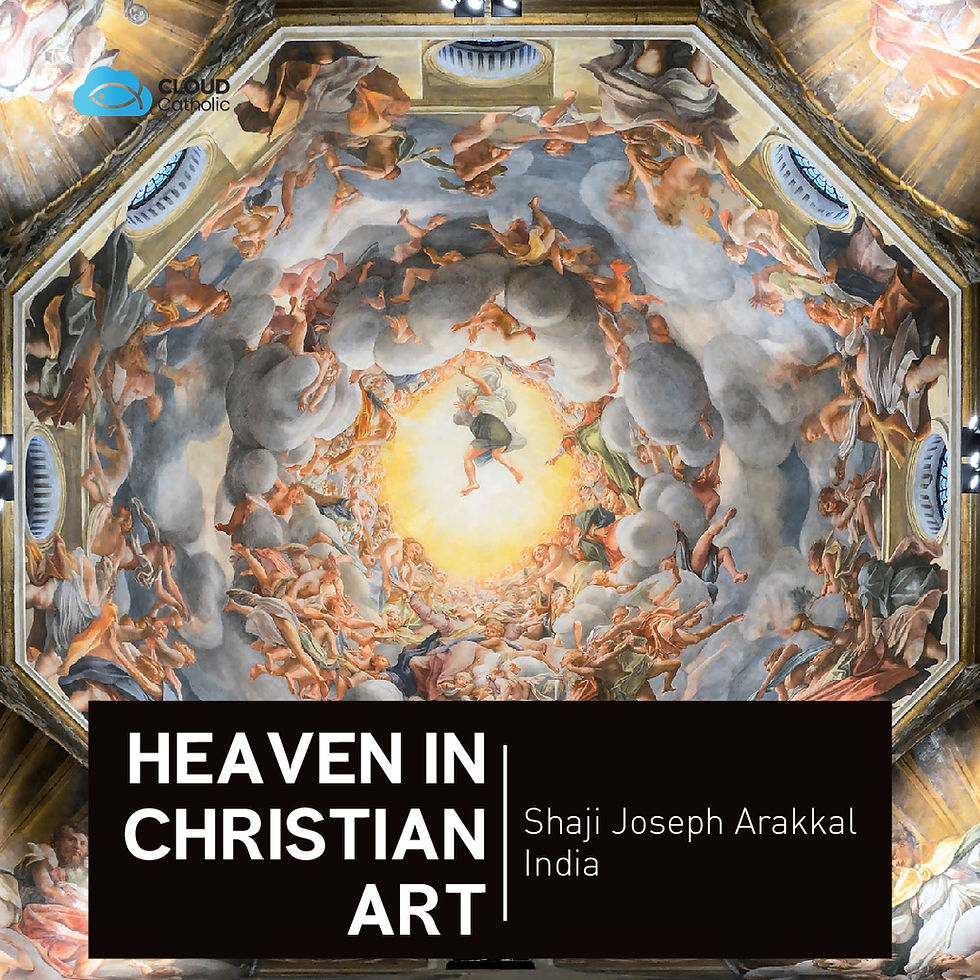
The 'Assumption of the Virgin' is a fresco painted inside the dome of the Cathedral of Parma in Italy. This composition belongs to the Italian Renaissance artist Antonio da Correggio. The painting of the 430 x 470 inch composition began in 1526 and was completed in 1530.
Correggio was a leading artist of the Parma school of painting (1520-50), a master of the illusory composition system.
The image depicts the Virgin Mary, clad in red and blue, ascending into the radiant light of heaven amidst clouds filled with angels, saints, and forefathers. Little angels surround Mary. The artist has created an illusion of depth and boundlessness through deliberate control of light by making distant bodies appear smaller in proportion to indicate distance.
The four patron saints of the city of Parma are depicted in the four corners. Saint John the Baptist with a lamb, Saint Hilary in a yellow robe, Saint Thomas and Saint Bernard.
In this massive composition, the entire architectural surface becomes one large pictorial unit, so that the viewer equates this dome of the church with the vault of heaven. Although this method was widely used by Italian Baroque artists, the method of introducing the viewer into the picture was a fantastic innovation at the time.
The Last Judgment by Michelangelo
Michelangelo's fresco 'The Last Judgment' on the altar of the Sistine Chapel in the Vatican is so famous that all of us would have seen it, if not in person. It is a depiction of Christ's second coming and final judgment. The painting has more than 300 figures, with Jesus and the Blessed Virgin standing in the centre, surrounded by angels and saints. Almost all the men and the angels are portrayed naked. Christ is also depicted partially naked and strong.
On either side of Christ are the blessed, below are those going to eternal damnation. In Matthew 25:31-46, we read that those on the right are saved and those on the left are cursed. However, we must understand that neither Pope Clement VII nor other clerical authorities prevented the free expression of the artist from executing this different composition.
The composition is done by limiting the colors. Sky blue and the light brown skin tones are prominent. Oranges, greens, yellows and whites and grays are scattered throughout, but a monochromatic character has been adopted to simplify and unify the complex scene.
Many of the figures have been damaged over time and have since been restored. Measuring 539 x 472 inches, it took five years from 1536 to 1541 to complete.
This painting has historically received both artistic and religious acclaim as well as criticism. Rigid bodies, nudity, deviations from conventional methods, and literal deviations from biblical verses may all be grounds for criticism. However, among the paintings done on 'heaven', it is this fresco by Michelangelo that stands out all over the world, having given visual expression to the verses from the Bible.
Shaji Joseph Arakkal has been a graphic designer for 39 years. He lives in Ernakulam, India with his wife Shoba. They have three children, Niranjana, Nirmal and late Niveditha.


Comments